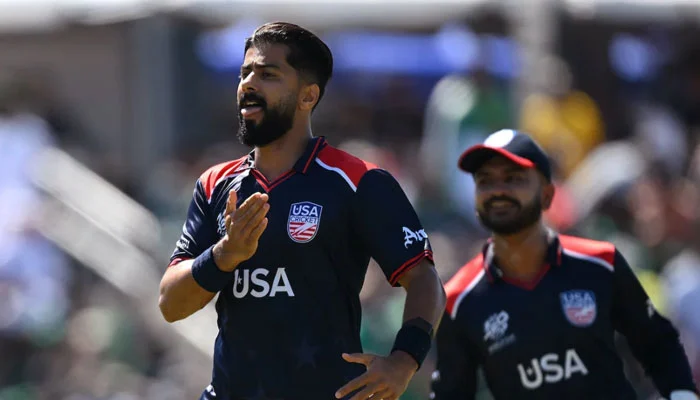
Visa Denied: USA Star Ali Khan’s World Cup Dream Hits a Wall Weeks Before Opener
The countdown to the 2026 T20 World Cup has hit a massive, frustrating snag for one of the tournament’s most intriguing underdogs. In a twist that feels less like sport and more like a geopolitical drama, USA Cricket’s star pacer Ali Khan revealed on Monday that his visa application for India has been rejected.
With the tournament just weeks away and the USA scheduled to play three of their four group games on Indian soil, the timing is nothing short of disastrous.
Taking to Instagram with a mix of dark humor and resilience, the 35-year-old posted a photo with the caption: “India visa denied but KFC for the win.” It was a lighthearted jab at a heavy situation, but make no mistake—inside the USA camp, nobody is laughing.
Why This is a Gut Punch for Team USA
Ali Khan isn’t just a squad player making up the numbers; he is the heartbeat of the American bowling attack. As the team prepares for a brutal Group A—featuring defending champions India, arch-rivals Pakistan, the Netherlands, and Namibia—losing their premier strike bowler is akin to going into a boxing match with one hand tied behind your back.
The blow is particularly severe given the schedule. The USA is set to walk out at the iconic Wankhede Stadium in Mumbai on February 7 for a blockbuster opener against India. Without Khan’s express pace and experience, an already daunting task just became near-impossible.
The Man Behind the Pace
To understand why this hurts so much, you have to look at Ali Khan’s journey. Born in Attock City, Punjab, Pakistan, his story is the ultimate American sporting dream. He moved to the US, worked hard, and eventually became the face of American cricket on the global franchise circuit.
He’s a player who doesn’t get starstruck. He’s played in the CPL, the IPL circuit, and PSL. He knows how to bowl to world-class batters because he’s been sharing dressing rooms with them for years.
Fans will remember his heroics in the 2024 World Cup, where he snagged the wickets of heavyweights like Rishabh Pant and Fakhar Zaman. He proved he belongs on the big stage. Now, right when he should be planning how to bowl to Suryakumar Yadav or Babar Azam again, he’s stuck dealing with paperwork and rejection letters.
The Elephant in the Room: Why the Denial?
While the official rejection didn’t come with a detailed explanation, the cricketing world knows the likely culprit: his place of birth.
Visa protocols between India and Pakistan are historically strict, and players of Pakistani origin representing other nations often face extra scrutiny. Usually, for ICC events, these wrinkles are ironed out because host nations are required to facilitate travel for all competing athletes. But this time, the red tape seems to have turned into a red light.
It’s a cruel irony. Khan is an American citizen representing a Full Member nation (in terms of World Cup participation), yet his birthplace is proving to be a hurdle that sport hasn’t quite managed to clear.
The Logistical Nightmare
This decision throws the USA’s logistics into chaos. Their schedule is heavily India-centric:
- Feb 7: vs India (Mumbai) – Khan Ruled Out
- Feb 10: vs Pakistan (Colombo, Sri Lanka) – Possible
- Feb 13: vs Netherlands (Chennai) – Khan Ruled Out
- Feb 15: vs Namibia (Chennai) – Khan Ruled Out
Technically, Khan could fly to Sri Lanka for the single game against Pakistan. But imagine the disruption—flying a key player in for one match, while the rest of the squad is based in India, completely destroys team rhythm and balance.
What Happens Next?
The ball is now in the court of diplomats and administrators. USA Cricket officials are scrambling, likely engaging with the BCCI and the ICC to appeal the decision. They will argue that blocking a key player jeopardizes the integrity of the competition.
If the decision isn’t reversed in the next few days, the USA will be forced to name a replacement. But let’s be honest: you can’t just replace a bowler who clocks 140kph+ and bowls lethal yorkers at the death.
For Ali Khan, this is devastating. At 35, this could well be his last shot at a World Cup on Asian soil. His Instagram caption shows he’s trying to stay positive, but it’s a bitter pill to swallow.
Sport is supposed to bridge divides, but today, it feels like bureaucracy has won. Fans can only hope that a last-minute resolution allows Ali Khan to trade that bucket of KFC for a Kookaburra ball at the Wankhede.