World Cup in Danger: ICC’s Emergency Flight to Dhaka as Bangladesh Threatens Total Boycott
The standoff that threatens to derail the ICC Men’s T20 World Cup 2026 has reached its breaking point.
With the tournament opener less than three weeks away, the International Cricket Council (ICC), under the chairmanship of Jay Shah, is preparing for what is being termed a “final act” of diplomacy. On Saturday, January 17, a high-level ICC delegation will land in Dhaka for a critical in-person meeting with the Bangladesh Cricket Board (BCB).
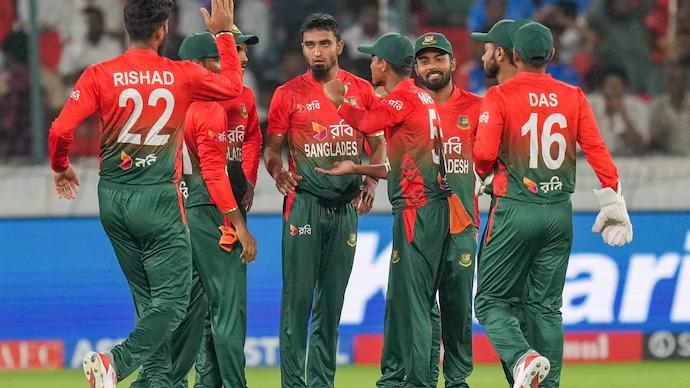
The mission is clear but fraught with difficulty: convince Bangladesh to drop its boycott of Indian venues and board the flight to Kolkata. If they fail, the cricketing world could witness the unprecedented withdrawal of a Full Member nation from a World Cup, a move that would have seismic consequences for the sport in the region.
Must Read: Mithun Death Threats, BPL Boycott & T20 World Cup Standoff
From Video Calls to Crisis Talks
The decision to send a physical delegation marks a significant escalation in urgency. Earlier this week, a video conference between ICC officials and the BCB brass—including President Aminul Islam and CEO Nizam Uddin Chowdhury—ended in a stalemate.
During that virtual meeting, the BCB refused to budge. Citing “safety and security concerns” for their players, they reiterated their demand: move Bangladesh’s Group C matches out of India and into Sri Lanka, the co-host nation. The ICC, having already sold tickets and finalized logistics for matches at Eden Gardens (Kolkata) and Wankhede Stadium (Mumbai), rejected the request, calling the security threats “baseless.”
Now, the ICC is taking the conversation offline. The hope is that face-to-face dialogue in Dhaka can break the deadlock that digital diplomacy could not.
The Catalyst: Why Bangladesh is Refusing to Travel
The root of this diplomatic freeze is not just cricketing; it is geopolitical.
The tension spiked earlier this year when the Board of Control for Cricket in India (BCCI) reportedly instructed the IPL franchise Kolkata Knight Riders (KKR) to release Bangladeshi pacer Mustafizur Rahman from their squad. The move was widely interpreted in Dhaka as a reaction to the strained political relations between the two neighbors and reports of unrest affecting minorities in Bangladesh.
The BCB viewed the “Mustafizur Incident” as a humiliation. In retaliation, the Bangladeshi government, through its Sports Adviser Asif Nazrul, has taken a hardline stance, stating that the national team will not travel to a country where they believe the atmosphere is hostile.
Bangladesh’s Scheduled Itinerary (Group C):
- Feb 7: vs West Indies (Kolkata)
- Feb 9: vs Italy (Kolkata)
- Feb 13: vs England (Kolkata)
- Feb 17: vs Nepal (Mumbai)
The irony is palpable: Bangladesh is scheduled to play three matches in Kolkata, the very city that is home to KKR, the franchise at the center of the dispute.
The Financial Myth: Why BCB Isn’t Blinking
One of the biggest questions surrounding this standoff has been the financial penalty. Surely, the BCB cannot afford to boycott an ICC event?
Surprisingly, the BCB claims they have nothing to lose financially.
Najmul Islam, the chairman of the BCB’s financial committee, recently dismissed the notion that a boycott would bankrupt the board.
“There will be no loss for the Bangladesh Cricket Board… Up to 2027, our revenue will not be hampered because in the 2022 ICC financial meeting, this was already fixed,” Islam told the media.
Because ICC revenue distribution models are locked in for multi-year cycles, the BCB believes their annual grant is secure regardless of participation in this specific tournament. This financial safety net has likely emboldened the board to maintain its aggressive posture.
The Real Losers: The Players
While the board might be financially insulated, the players are not.
For the cricketers, match fees from ICC tournaments are a significant chunk of their annual earnings. A boycott means zero match fees for the squad. Furthermore, missing a World Cup denies emerging stars the platform to secure lucrative franchise contracts in leagues like the SA20, ILT20, or the Big Bash.
Reports suggest a rift is brewing within the team. The players, naturally, want to play. It is their career peak, and for rookies, a once-in-a-lifetime opportunity. However, the BCB has made it clear: there will be no compensation for lost earnings.
“If they play in a tournament and don’t perform, do we ask for that money back? … If the board itself does not exist, will the players exist?” Najmul Islam argued, using a bizarre “body and hands” metaphor to justify the lack of compensation.
What Happens on January 17?
Saturday’s meeting in Dhaka is the endgame.
The ICC’s Leverage:
- Sanctions: While revenue might be fixed, the ICC could threaten suspension of membership or exclusion from future Future Tours Programme (FTP) cycles.
- Security Assurances: The delegation will likely present a “Head of State” level security plan, authorized by the Indian government, to guarantee the team’s safety.
The BCB’s Leverage:
- Public Sentiment: The board is riding a wave of nationalism at home. Backing down and traveling to India without concessions could be seen as a sign of weakness by their domestic audience.
If the talks fail, the ICC faces a logistical nightmare. They would have to decide whether to:
- Cancel Bangladesh’s matches (awarding points to opponents).
- Invite a replacement team on short notice (highly unlikely).
- Cave in and move the matches to Colombo (a logistical disaster this close to the event).
For cricket fans, the hope is simple: that politics can be put aside for the sake of the game. But as the ICC delegation boards their flight to Dhaka, the mood is tense. The T20 World Cup 2026 is about to start, but one of its key participants is still refusing to walk onto the field.