T20 World Cup 2026 Warm-up: Afghanistan Defeats Scotland in Dominant Fashion
Bengaluru, February 2, 2026 – If the rest of the cricketing world thought Afghanistan’s semi-final run in 2024 was a fluke, Monday’s proceedings at the BCCI Centre of Excellence Ground 1 served as a loud, undeniable wake-up call. In their opening warm-up fixture for the ICC Men’s T20 World Cup 2026, Afghanistan didn’t just beat Scotland; they dismantled them with a clinical precision that suggests the Asian side has evolved from “dark horses” to genuine title contenders.
Despite a shaky start that saw them reeling early on, Afghanistan showcased remarkable depth and resilience to post a commanding 184/6, before their bowling unit—led by the fierce Azmatullah Omarzai—skittled Scotland for a meager 123. The 61-run margin of victory is significant, but it is the manner of the win that will have analysts talking.
The Resurrection: From 20/2 to 184/6
The match began with high drama. Afghanistan captain Rashid Khan won the toss and elected to bat, testing his side’s ability to set a target on a Bengaluru surface that offered early nibble for the seamers.
Scotland’s Brad Currie exploited these conditions perfectly. Delivering a disciplined opening spell, Currie removed the Afghan openers cheaply, reducing the formidable batting lineup to a precarious 20/2 inside the first four overs. For a moment, it seemed the ghosts of batting collapses past were haunting the Afghans.
However, what followed was a masterclass in crisis management followed by brutal acceleration.
The Rasooli & Zadran Alliance
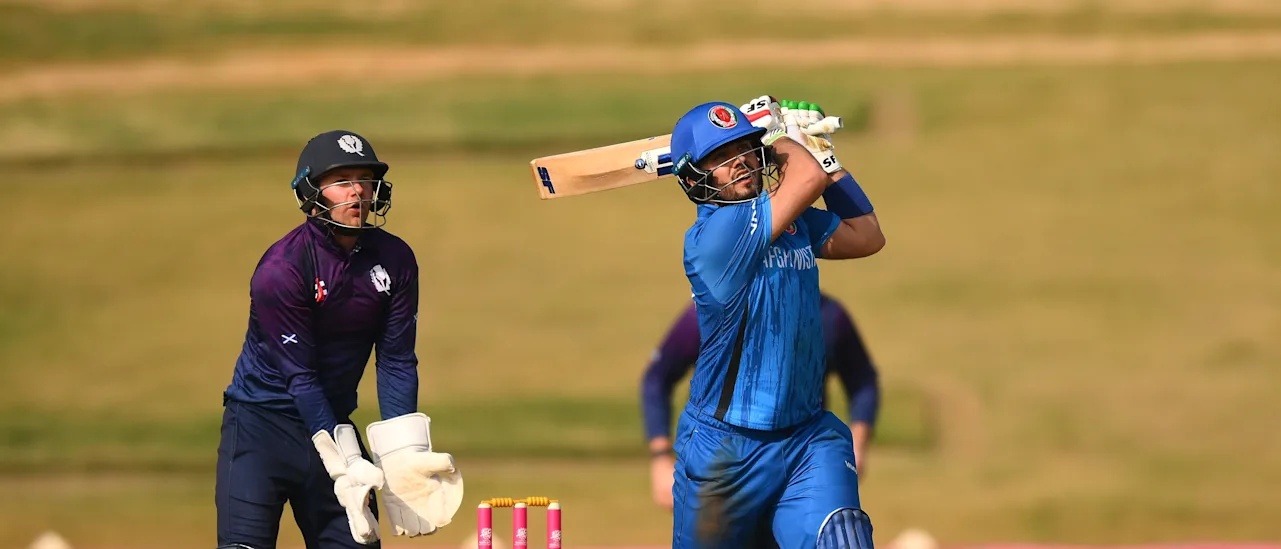
Enter Darwish Rasooli. While Ibrahim Zadran (36) played the anchor role, absorbing the pressure and rotating the strike, Rasooli decided to counter-attack. The duo stitched together a crucial 82-run partnership for the third wicket, effectively nullifying Scotland’s early advantage.
Once the nerves settled, the gears shifted. The statistics tell a frightening story for opposition bowlers: Afghanistan scored a massive 107 runs in the final 10 overs.
Match Stats: Afghanistan Batting Highlights
| Batter | Runs | Balls | 4s | 6s | Strike Rate | Status |
| Darwish Rasooli | 84 | — | 7 | 5 | High | Retired Hurt |
| Ibrahim Zadran | 36 | — | — | — | Moderate | Out |
| Mohammad Nabi | 34 | 16 | — | — | 212.50 | Out |
| Total Score | 184/6 | 20 Overs | 9.2 RPO |
Rasooli’s knock of 84 was the highlight of the day. Punctuated by seven boundaries and five towering sixes, he displayed a range of shots that combined traditional elegance with modern T20 power. His eventual departure, retiring hurt, was likely precautionary, but the damage was done. Veteran Mohammad Nabi then applied the finishing touches, blasting a quickfire 34 off just 16 balls to push the total beyond the 180-mark.
Scotland’s Bowling: A Tale of Two Halves
Scotland will look back at this innings with regret. They had their foot on Afghanistan’s throat in the powerplay but failed to maintain the pressure. While Brad Currie was standout with his economy and wicket-taking ability, the supporting cast faltered under the assault from Rasooli and Nabi.
Three Scottish bowlers leaked runs at over 11 runs per an over, a statistic that is fatal in the T20 format. While Jack Jarvis and Mark Watt picked up two wickets apiece, they were expensive, trading wickets for runs in a manner that allowed Afghanistan to build momentum.
Scotland Bowling Card (Key Performers)
| Bowler | Wickets | Runs Conceded | Economy Analysis |
| Brad Currie | 1 | 19 | Excellent (The Pick of the Bowlers) |
| Jack Jarvis | 2 | High | Expensive |
| Mark Watt | 2 | High | Expensive |
The Chase: The Blue Wall Stands Tall
Chasing 185 for victory against Afghanistan’s bowling attack is arguably one of the toughest tasks in world cricket. Scotland needed a flyer in the powerplay, but they ran into a wall of discipline and aggression.
The Scottish innings never truly gained momentum. While the surface eased out slightly under lights, the Afghan bowlers varied their pace and lengths beautifully. Scotland lost wickets at regular intervals, preventing any significant partnerships from blossoming.
Three batters—Michael Jones, Brandon McMullen, and wicketkeeper Matthew Cross—managed to get starts, crossing the 20-run mark. However, in a chase of this magnitude, 20s do not win matches. They needed someone to pull a “Rasooli,” but the Afghan attack was relentless.
Match Stats: Scotland Batting Struggle
| Batter | Score | Analysis |
| Michael Jones | 20+ | Failed to convert start |
| Brandon McMullen | 20+ | Struggle to accelerate |
| Matthew Cross | 20+ | Lacked support |
| Total Score | 123 All Out | 19.3 Overs |
Afghanistan Bowling: Seam and Spin in Harmony
The most encouraging sign for Afghanistan ahead of the main tournament was the performance of their seamers. Usually reliant on their world-class spinners, it was seamer Azmatullah Omarzai who broke the back of the Scottish lineup.
Omarzai returned sparkling figures of 3/14 in three overs, showcasing swing upfront and clever variations at the death. He was ably supported by the evergreen Mohammad Nabi. The veteran all-rounder proved he is still a force to be reckoned with, removing Scotland captain Richie Berrington and Finlay McCreath in successive overs, effectively killing the chase in the middle phase.
Gulbadin Naib also produced a moment of magic, uprooting Michael Leask’s stumps with a delivery that pierced through the middle—a visual metaphor for Afghanistan’s dominance on the day.
Match Stats: Afghanistan Bowling Figures
| Bowler | Wickets | Runs | Overs | Economy |
| Azmatullah Omarzai | 3 | 14 | 3.0 | 4.66 |
| Mohammad Nabi | 2 | — | — | Excellent |
| Gulbadin Naib | 1 | — | — | — |
Analysis: What This Means for T20 World Cup 2026
This victory serves as more than just a warm-up win; it is a tactical blueprint of how Afghanistan plans to approach the 2026 World Cup in India.
- Batting Depth: The recovery from 20/2 proves that their middle order is no longer brittle. They can absorb pressure and launch late assaults.
- The Rise of Rasooli: In Darwish Rasooli, they have found a destructive batter who can take the game away from the opposition in the middle overs—a crucial role in Indian conditions.
- Fast Bowling Resources: With Omarzai firing, Afghanistan is no longer a one-dimensional spin-heavy team. They have pacers who can exploit the conditions.
- Scotland’s Woes: For Scotland, the heavy defeat highlights a lack of depth in handling quality bowling and an inability to close out bowling innings. They have work to do before their next fixture against Namibia.
The Road Ahead
The preparations continue as teams look to fine-tune their squads before the main event kicks off.
- Afghanistan will face the mighty West Indies on February 4 in what promises to be a clash of power-hitters.
- Scotland will look to bounce back against Namibia on the same day, a match they will feel is a must-win for their confidence.
Verdict: Afghanistan looks sharp, hungry, and dangerous. If this warm-up is any indication, the 2024 semi-finalists are not just here to participate; they are here to dominate.