Indian Dressing Room in Turmoil: Gambhir’s Gill Decision Sparks T20 World Cup Uncertainty Crisis
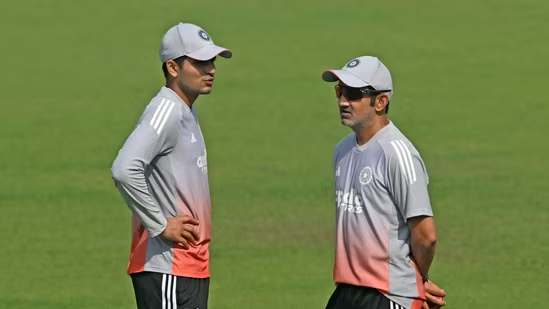
The Indian cricket dressing room is experiencing unprecedented turmoil just weeks before the T20 World Cup, with players reportedly feeling “confused and not secured” under head coach Gautam Gambhir’s leadership. The shocking decision to drop Shubman Gill from the T20 World Cup squad has triggered a wave of uncertainty that’s shaking the very foundation of team dynamics heading into cricket’s biggest stage.
What seemed like a straightforward selection call has morphed into something far more troubling—a crisis of confidence that has players questioning their futures and the direction of Indian cricket. When your designated next-generation leader gets axed after being given assurances, everyone else starts wondering: who’s next? With the T20 World Cup 2026 beginning February 7 across India and Sri Lanka, this internal chaos couldn’t have come at a worse time for the defending champions.
The Shubman Gill Saga: From Future Captain to World Cup Casualty
The BCCI’s decision to exclude Gill represents one of the most stunning reversals in recent Indian cricket selection history. Just four months ago, the 25-year-old was being groomed as India’s all-format captain—the heir apparent to Rohit Sharma’s legacy. Now he’s watching the World Cup from home, and the entire squad is processing what that means for their own security.
Gill’s Rapid Rise and Dramatic Fall
| Timeline | Status | Details |
|---|---|---|
| September 2024 | T20I Return | Brought back after 1+ year absence |
| September 2024 | Vice-Captain | Reinstated with assurances of long-term role |
| September-December 2024 | Regular Starter | Played every T20I, given “free run” |
| December 2024 | Dropped | Excluded from T20 World Cup squad |
| Current Status | ODI/Test Captain | Retains leadership in longer formats only |
The numbers tell the story of why selectors lost patience. Despite playing 15 T20I innings with guaranteed backing from management, Gill managed just 291 runs without a single fifty. His average hovered around 19, and his strike rate failed to match modern T20 demands. The final straw came during the South Africa home series where he scored 4, 0, and 28 in consecutive matches.
But here’s what makes this situation explosive: Gill’s return to T20Is reportedly cost Sanju Samson his secure place in the lineup. Samson, who was in red-hot form, found himself benched or batting out of position to accommodate Gill. Now that Gill’s gone, Samson’s back—creating an awkward dynamic that players haven’t missed.
Gambhir’s Fingerprints All Over the Decision
According to PTI reports, the decision to drop Gill “had Gambhir’s footprints written all over it.” This suggests the head coach either pushed for Gill’s exclusion or failed to protect him despite earlier assurances. Either scenario damages Gambhir’s credibility with the squad.
Players who spoke on condition of anonymity described the current dressing room environment as dramatically different from the Rahul Dravid era. Under Dravid’s three-year tenure, roles were clearly defined, players understood their positions, and everyone received adequate opportunities to prove themselves. The atmosphere was secure, methodical, and transparent.
Under Gambhir? Not so much.
The Dravid vs Gambhir Coaching Comparison
Rahul Dravid’s Approach (2021-2024):
- Clear role definitions for every player
- Long rope to work through poor form
- Transparent communication about expectations
- Consistent selection policies
- Players felt secure and trusted
Gautam Gambhir’s Approach (2024-Present):
- Sudden selection reversals without clear explanations
- Players uncertain about their standing
- “Confused arena” atmosphere in dressing room
- Rapid changes in strategy and personnel
- Security and trust issues emerging
The contrast couldn’t be starker. Dravid’s India won the 2024 T20 World Cup with a settled squad that understood their roles perfectly. Gambhir’s India is heading into the 2026 edition with players looking over their shoulders, wondering if they’re next on the chopping block.
“If the Poster Boy Gets Dumped, Anyone Can Be Next”
This quote from PTI’s report captures the psychological damage Gill’s exclusion has caused. Shubman Gill wasn’t just another player—he was positioned as Indian cricket’s next poster boy, the face of the next generation, the designated successor to Virat Kohli and Rohit Sharma.
If management can discard someone with that much institutional investment after giving explicit assurances, what protection do regular players have? The message received by the dressing room: Nobody’s safe, promises mean nothing, and form alone might not save you.
This creates a toxic environment heading into a World Cup. Players need confidence, not paranoia. They need to play freely, not worry about political survival. Yet that’s exactly what Gambhir’s regime has allegedly created. Check the complete tournament schedule to see how little time India has to fix these internal issues before competition begins.
The Broader Context: Gambhir’s Troubled Tenure
Gill’s exclusion doesn’t exist in isolation—it’s part of a broader pattern of struggles under Gambhir’s coaching. While India has performed well in white-ball cricket (winning the Champions Trophy and T20 Asia Cup in 2025), the Test cricket situation has been catastrophic.
India’s Recent Test Cricket Disasters
- Home whitewash vs New Zealand: First-ever 3-0 loss on Indian soil
- Away whitewash vs Australia (Border-Gavaskar Trophy): Lost 1-3 in humiliating fashion
- Questions about red-ball strategy: Gambhir’s Test methods under intense scrutiny
These Test failures have already put Gambhir’s position under review. The BCCI is reportedly considering a split-coaching model where Gambhir handles white-ball formats while someone else takes charge of Tests. The T20 World Cup has become a referendum on his entire coaching career.
Here’s the pressure: India must win this World Cup, or Gambhir’s tenure as all-format coach likely ends. That pressure trickles down to players, creating the exact insecurity that’s already plaguing the dressing room.
The Sanju Samson Factor: Collateral Damage and Redemption
Sanju Samson’s journey through this saga deserves attention. The Kerala wicketkeeper-batsman was enjoying his best international phase, establishing himself as a reliable top-order option with explosive capabilities. Then Gill returned, and Samson found himself shunted around or dropped entirely.
Now Gill’s out, Samson’s back in, and the dressing room is processing these rapid reversals. Players close to both understand the awkwardness—Gill likely resents losing his spot, Samson probably harbors frustration about being moved aside in the first place, and teammates wonder who gets sacrificed next time management changes its mind.
This instability destroys team chemistry. Successful squads need internal harmony, not players competing for political favor or wondering when the rug gets pulled from under them.
What This Means for India’s World Cup Chances
Can a confused, insecure dressing room win a World Cup? History suggests it’s extremely difficult. Championship teams typically share certain characteristics:
World Cup Winning Teams Usually Have:
- Clear roles and settled combinations
- Players confident in their positions
- Strong trust between players and management
- Consistent selection policies
- Minimal internal politics
- United dressing room culture
India’s Current Situation:
- Frequent selection reversals creating confusion
- Players unsure of their standing
- Broken promises eroding trust
- Inconsistent strategies from management
- Potential factional tensions
- Atmosphere described as “not secure”
The talent is undeniable—India possesses world-class players across all departments. But talent alone doesn’t win tournaments. Ask any number of gifted teams that underperformed due to internal issues. If players are thinking about job security instead of match situations, performance suffers.
BCCI’s Dilemma: Split Coaching or Complete Change?
The PTI report reveals the BCCI is prepared to make coaching changes if the World Cup goes poorly. The options being considered:
Potential Coaching Scenarios Post-World Cup
| Scenario | Probability | Details |
|---|---|---|
| Status Quo | Low | Only if India wins T20 World Cup convincingly |
| Split Coaching | Medium-High | Gambhir keeps white-ball, new Test coach hired |
| Complete Change | Medium | New coach for all formats if WC performance disappoints |
| Gambhir Survives | Very Low | Would require T20 WC win + improved team dynamics |
The report specifically states: “People who have the last word in the BCCI will have enough time to take an informed call about split coaching or having a single coach across formats, after analysing India’s performance at the global meet.”
Translation: Gambhir’s on probation, and the World Cup is his final exam. Fail, and he’s likely gone. Even a semifinal exit might not save him given the dressing room atmosphere reports.
Player Reactions and Anonymous Sources
Multiple players reportedly spoke to journalists on background, confirming the uncertain atmosphere but refusing to go on record. That itself tells you something—players fear repercussions for speaking openly, another sign of a troubled environment.
Compare this to the Dravid era, where players freely praised the coaching staff and team culture in public. The silence now speaks volumes. When cricketers clam up instead of defending their coach, you know there’s fire beneath all that smoke.
Some players have subtly supported Gill through social media interactions, liking posts questioning his exclusion or commenting supportively on his non-cricket content. These small gestures hint at broader dressing room sentiment that the decision was harsh or politically motivated.
The Road Ahead: Six Weeks to Fix a Fractured Team
India has roughly six weeks before their World Cup opener. That’s barely enough time to finalize combinations, let alone repair fractured team dynamics and rebuild trust between players and management. For the latest cricket updates as India navigates this crisis, keep checking our comprehensive coverage.
What needs to happen for India to succeed:
Immediate Priorities:
- Gambhir must address team concerns transparently
- Clear communication about selection policies going forward
- Rebuild trust through consistent messaging and actions
- Ensure dropped players (like Gill) don’t create factional issues
- Focus on cricket, not internal politics
Long-term Considerations:
- BCCI needs to evaluate coaching structure regardless of WC result
- Player welfare and mental security must improve
- Selection policies require greater consistency
- Management-player relationship needs rebuilding
Frequently Asked Questions
Why was Shubman Gill dropped from India’s T20 World Cup squad? Gill was excluded after scoring just 291 runs in 15 T20I innings without a single fifty, including poor performances (4, 0, 28) against South Africa. Despite being given a guaranteed run as vice-captain, his form failed to justify continued selection.
Is Gautam Gambhir’s job as India coach in danger? Reports suggest Gambhir is under significant pressure following Test whitewashes and dressing room uncertainty. The BCCI is considering split-coaching models, and his future likely depends on T20 World Cup performance.
How does the current Indian dressing room atmosphere compare to the Dravid era? Players reportedly felt secure and trusted under Rahul Dravid’s clear role definitions and consistent policies. Under Gambhir, sources describe a “confused arena” where players feel insecure about their positions following sudden selection reversals.
Will Shubman Gill return to India’s T20I team after the World Cup? While Gill retains his ODI and Test captaincy, his T20I future is uncertain. His return would depend on domestic form, management’s long-term vision, and whether current dressing room dynamics improve.
When does the T20 World Cup 2026 begin? The tournament starts February 7, 2026, across venues in India and Sri Lanka, giving India’s troubled squad just six weeks to resolve internal issues and finalize combinations.
Could India still win the T20 World Cup despite dressing room problems? While India possesses exceptional talent, winning tournaments typically requires internal harmony and player confidence—both currently lacking. Championship teams rarely succeed amid confusion and insecurity, though India’s quality gives them a fighting chance.
The Final Verdict
India approaches the T20 World Cup as defending champions but with a fractured dressing room that threatens to undermine their title defense. Shubman Gill’s shocking exclusion has exposed deeper issues within Gautam Gambhir’s coaching regime—a lack of clarity, broken promises, and an atmosphere where even designated future leaders aren’t safe.
Can India overcome internal turmoil to retain their crown? Talent suggests yes, but history warns that confused, insecure teams rarely succeed on the biggest stages. The next six weeks will reveal whether Gambhir can repair the damage and unite his squad, or whether India’s dressing room problems doom their championship hopes before a ball is bowled.
Want to witness whether India can turn this crisis into triumph? Grab your World Cup tickets now and watch the drama unfold as the defending champions battle external opponents and internal demons simultaneously. One thing’s certain: this tournament will define careers, coaching futures, and the direction of Indian cricket for years to come.