Bangladesh Umpire in India Amid BCB Security Fears: A Paradox of Protocol vs. Politics
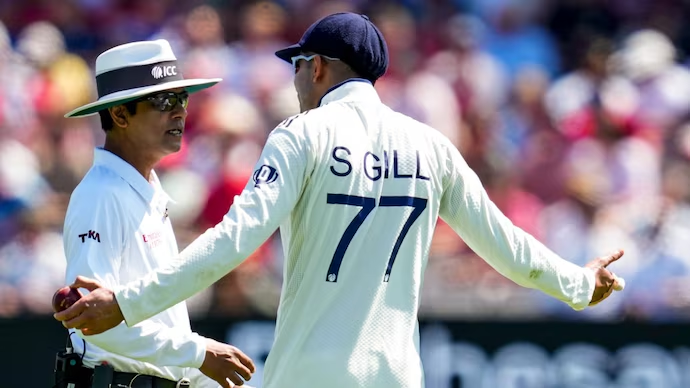
On Sunday afternoon in Vadodara, amidst the roar of the crowd at the Kotambi Stadium for the India vs New Zealand ODI, a quiet but profound contradiction was playing out in the third umpire’s booth. The man monitoring the run-outs and no-balls was Sharfuddoula Saikat, a respected Bangladeshi official.
Under normal circumstances, this would be routine. But in the current geopolitical climate of Asian cricket, Saikat’s presence in India is a diplomatic anomaly. It stands in stark, confusing contrast to the official stance of his home board. The Bangladesh Cricket Board (BCB) has formally petitioned the ICC to move their T20 World Cup matches out of India, citing grave “security concerns” and threats to “national dignity.”
How can a country claim a host nation is unsafe for its eleven players, while simultaneously allowing one of its officials to work there? This paradox has become the latest flashpoint in a saga that threatens to overshadow the upcoming T20 World Cup 2026.
The Optics vs. The Fine Print
The optics are undeniably awkward. To the casual observer, the situation screams of hypocrisy. If the threat level in India is high enough to warrant a venue shift for the national team, surely it is high enough to recall an umpire?
However, the BCB’s defense relies on the cold, hard text of contracts. Iftekhar Rahman, chairman of the BCB umpires’ committee, was quick to separate the board from the individual.
- The Technical Defense: Saikat is an ICC Elite Panel umpire. His contract is with the world governing body, not strictly the BCB.
- The Obligation: Rahman explained, “When he has any ICC assignment, he will automatically be on leave from us… There is no authority for me to decide whether I give permission or not.”
In essence, the BCB is washing its hands of the decision. They argue that blocking Saikat would put them in breach of ICC regulations. While legally sound, this defense does little to quell the political storm. It creates a scenario where international obligations are overriding the very “national dignity” the government claims to be protecting.
The Trigger: The Mustafizur Rahman Saga
To understand why this umpire issue is so sensitive, one must look at the detonator of this entire crisis: Mustafizur Rahman.
The relationship between the BCCI and BCB, usually cordial, fractured when the left-arm pacer was abruptly removed from the Kolkata Knight Riders (KKR) squad for IPL 2026. The reasons remain murky, but in Dhaka, it was interpreted not as a cricketing decision, but as a slight.
- The Fallout: The reaction was swift and severe. Bangladesh’s government, led by Sports Advisor Asif Nazrul, didn’t just complain; they retaliated. The broadcast of the IPL has been banned indefinitely in Bangladesh—a move unprecedented in the league’s history.
- The Escalation: The narrative shifted from “player selection” to “national humiliation.” The BCB’s subsequent letters to the ICC, demanding a venue change for the World Cup, were framed around the safety of players in a hostile environment.
Weakening the Case?
Saikat’s seamless participation in the Vadodara ODI potentially weakens the BCB’s argument to the ICC. The Board of Control for Cricket in India (BCCI) can now point to Saikat and ask a simple question: “If your umpire is safe, comfortable, and working in our state-of-the-art facilities, why wouldn’t your players be?”
Security threats are usually blanket concerns. It is rare for a country to be deemed unsafe for players but safe for officials. By allowing Saikat to officiate, the BCB has inadvertently provided the BCCI with visual evidence that the “security threat” might be more political posturing than physical reality.
The “National Dignity” Dilemma
Asif Nazrul’s comments have raised the stakes beyond cricket. “We do not want to play the World Cup at the cost of national humiliation,” he stated.
This rhetoric boxes the BCB into a corner. If the ICC rejects their request to move matches to Sri Lanka (or Pakistan, as offered by the PCB), the BCB faces a humiliating climbdown.
- Option A: Boycott the World Cup, facing heavy ICC sanctions and isolation.
- Option B: Travel to India anyway, contradicting their own government’s stance on “dignity.”
Saikat’s presence suggests that when push comes to shove, international commitments (like ICC contracts) still hold weight. It hints that a full boycott is unlikely, despite the fiery rhetoric.
The Human Element: Sharfuddoula Saikat
Caught in the crossfire is Sharfuddoula Saikat himself. As the first Bangladeshi umpire to be elevated to the ICC Elite Panel, he is a trailblazer. His job is stressful enough—making split-second decisions that can decide matches—without the added burden of being a geopolitical pawn.
Currently, in Vadodara, he is likely isolated, perhaps advised to keep a low profile. He represents the uncomfortable middle ground: a professional trying to do his job while his employers back home engage in a diplomatic war with his hosts.
Conclusion: A Test for the ICC
The ball is now firmly in the ICC’s court. They must navigate a minefield.
- The precedent: Moving matches based on “political tension” rather than “proven security threats” sets a dangerous precedent.
- The contradiction: They cannot easily validate the BCB’s security fears while utilizing a Bangladeshi umpire in the same country.
As the India vs New Zealand series continues, every decision Saikat makes will be scrutinized—not just for cricketing accuracy, but as a symbol of the strange, disjointed reality of Asian cricket politics. For now, the umpire stands in the middle, while the administrators fight on the sidelines.